A Number Is Not a Story: Why Curiosity Beats Judgment in Research Findings


When it comes to marketing research, numbers alone aren’t compliments, criticisms, or judgments.
They’re neutral. But as any of us in higher ed marketing know, they rarely feel that way because budgets, staffing, and reputations often hinge on them:
- A dip in awareness can feel like a direct reflection on your work.
- A drop in engagement can spark budget questions.
- Falling behind a peer institution can make a board member ask, “Why?” in that way that means, defend yourself.
I’ve seen a single slide change the whole energy of a research presentation. If a number is up, people relax. If it’s down, the tension is immediate. But either reaction can distract you from what the number is really telling you.
It’s human to react. Data can have real consequences. But judgment—whether it’s pride over a high number or dread over a low one — almost always narrows the conversation. And narrow conversations don’t produce better insights.

Numbers Aren’t The End; They’re The Starting Point
Every number is a signal and a snapshot of right now. The “good” versus “bad” binary we default to? That’s just a caption we add to the picture.
A “good number” can hide trouble, like outperforming your peer average only because their scores dropped faster than yours. And a “bad” number can open the right door, like a dip in engagement that turns out to be concentrated in one segment you’ve been neglecting.
Of course, some numbers do demand immediate attention, like a sudden enrollment drop that requires intervention. But even then, understanding why helps determine how to react.
When a number is “good,” we often stop asking questions about it: why is it high? How do we sustain it? And when it’s “bad,” we may want to explain it away or avoid uncomfortable truths.
Either way, we miss the opportunity to understand what’s really going on.
The goal isn’t to cushion a low score or downplay a high one. The goal is to approach both the same way: as an open door to insight.
Curiosity Is the Real Competitive Edge
We all need to be a little Ted Lasso when it comes to data—curious, not judgmental.
Curiosity doesn’t mean delaying action. It means diagnosing the problem accurately before deciding how to address it. It keeps the conversation going and invites better questions:
- What’s driving this number up or down?
- Who’s represented here—and who’s missing?
- How does this connect to other trends we’re seeing?
- Is this a new shift or part of a longer pattern?

Common Pitfalls in Interpreting Findings
It’s easy to fall into these traps:
- Cherry-picking results to fit a narrative.
- Focusing too much on vanity metrics—numbers that look good but don’t drive results.
- Focusing on too many metrics, getting distracted by noise instead of zeroing in on what really matters.
- Treating benchmarks as gospel without considering the context.
- Mistaking correlation for causation, equating concurrence with cause-and-effect.
- Stopping at the “what” without probing the “why.”
- Reacting to numbers in isolation without considering resource constraints or operational realities.
A curiosity-first approach short-circuits all of these and leads to deeper understanding.
Applying Curiosity to Communication
Yes, findings still have to be shared, sometimes in rooms where the stakes are high, and patience is low. That’s where curiosity equips you to frame the conversation for others.
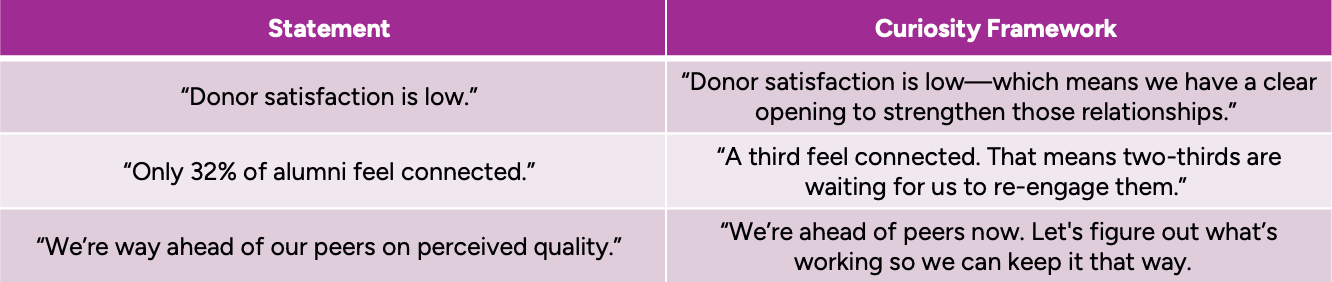
This doesn’t mean sugarcoating results. Stakeholders need clear information about risks and gaps. Curiosity frames those gaps as solvable problems rather than fixed failures.
This isn’t spin; it’s context—a way to keep the focus on what’s possible next instead of what just happened.

The Long Game
A curiosity-first mindset influences more than how you read one report; it shapes how findings are used over time. In a landscape where budgets are tight, priorities shift quickly, and the stakes are high, that perspective matters. Building this mindset takes time and deliberate modeling by leadership, especially in cultures where numbers have historically been used to assign blame.
Curiosity is a mindset shift for interpreting data and a brand-building discipline that transforms data into differentiated positioning, actionable insights, and cultural change. Over time, it can:
- Make teams more willing to surface uncomfortable truths and start acting on them, like flagging a drop in brand perception before it affects rankings or recruitment.
- Support a culture of accountability without blame or panic, so a dip in engagement becomes a shared problem to solve.
- Frame gaps as opportunities for connection, clarity, or alignment—for example, viewing lower alumni affinity in one region as a chance to rethink event formats or outreach.
- Strengthen your ability to respond to change because patterns are spotted earlier and turned into flexible action plans.
No one can control every number on the dashboard. But we can control how we react to them, shifting those tense “why” moments into “what’s next” conversations.
Numbers aren’t the story. The story is what we learn from them and how we respond to them under pressure, with limited resources, and real consequences.
__
Curious what the numbers say about your institution’s measurement gaps? The Higher Ed CMO Study tells you what to do next. Read Chapter 3 to see how CMOs are closing the gap between the metrics they track and the questions that matter.


